
As Microsoft continues expanding its AI, cloud computing, security, and enterprise automation ecosystem, the Microsoft certification landscape is also undergoing major transformation. Several well-known Azure and AI certifications will officially retire in 2026, while Microsoft introduces new replacement certifications aligned with the future of AI-driven cloud technologies.
For learners preparing for Microsoft certification exams, existing Azure-certified professionals, and IT practitioners planning to move into AI engineering, cloud development, cybersecurity, or MLOps, understanding these changes early is extremely important.
This article provides a detailed analysis of Microsoft certification retirements in 2026, replacement certification paths, technology trends behind these updates, and what they mean for future career development.
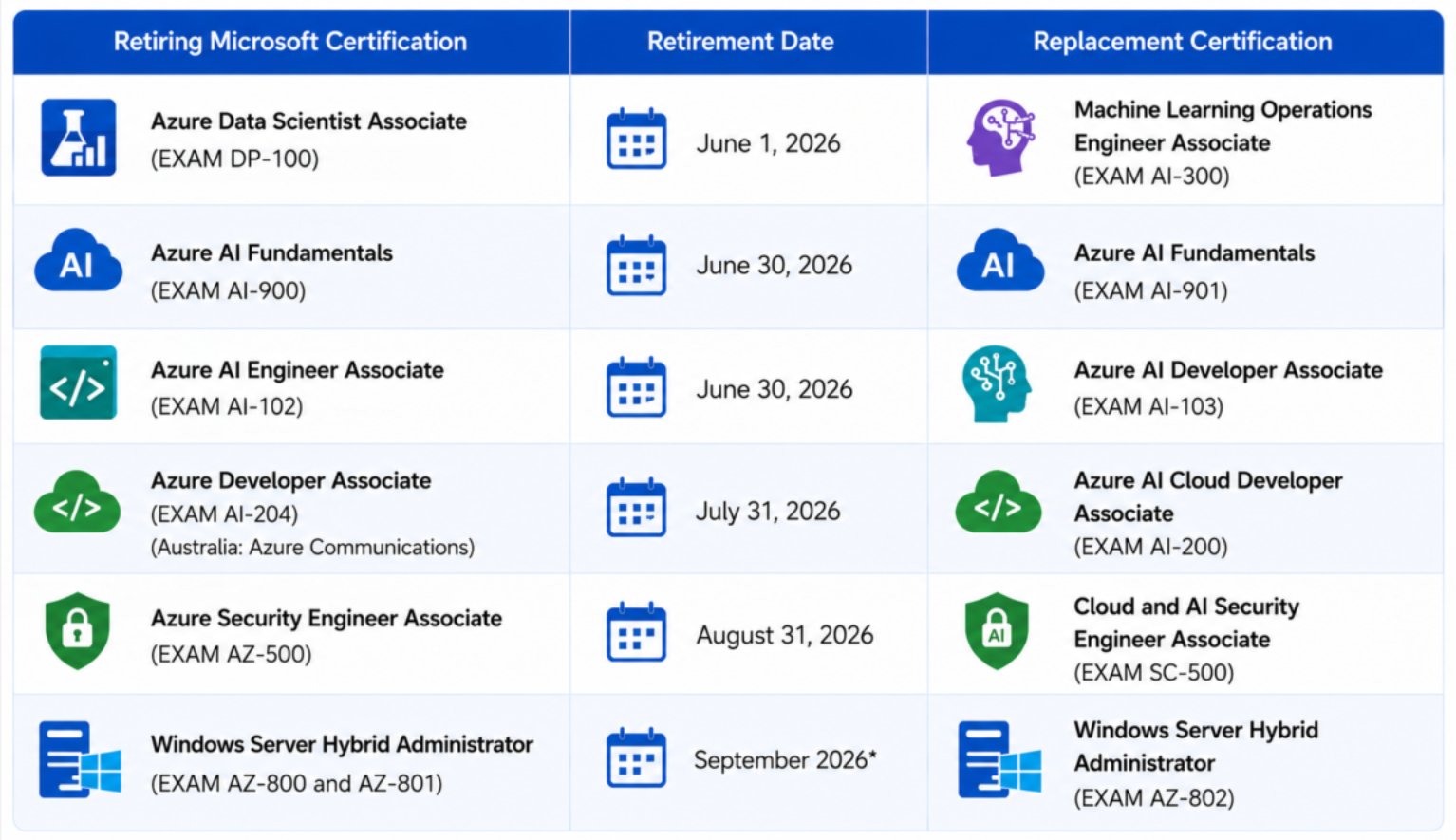
Azure Data Scientist Associate (DP-100) Will Retire
- Certification: Azure Data Scientist Associate
- Exam Code: DP-100
- Retirement Date: June 1, 2026
- Training Retirement: April 2026
- Replacement Certification: Machine Learning Operations (MLOps) Engineer Associate (AI-300)
DP-100 has long been one of Microsoft's primary certifications for Azure machine learning and data science professionals. The certification focused on:
- Data science workflows
- Model training
- Experiment management
- Azure Machine Learning platform usage
With the introduction of AI-300, Microsoft is clearly shifting its focus from traditional data science toward production-level AI engineering and MLOps practices.
The new certification is expected to emphasize:
- AI model deployment
- ML lifecycle management
- Automated machine learning workflows
- Model monitoring and optimization
- Enterprise AI operational practices
- Cross-team AI collaboration
This transition reflects Microsoft's broader strategy of moving from “data science” toward scalable AI engineering.
Azure AI Fundamentals Is Being Updated (AI-900 → AI-901)
- Current Certification: Azure AI Fundamentals (AI-900)
- Retirement Date: June 30, 2026
- Training Retirement: April 2026
- Replacement Certification: Azure AI Fundamentals (AI-901)
AI-900 has traditionally served as Microsoft's entry-level AI certification, designed for:
- Beginners in AI
- Cloud learners
- Business professionals
- Non-technical managers
- Students entering AI-related careers
The new AI-901 certification is expected to include more modern AI concepts such as:
- Generative AI fundamentals
- AI Agents
- Copilot technologies
- Responsible AI
- Azure OpenAI basics
This change demonstrates that Microsoft's AI certification roadmap is rapidly adapting to the generative AI era.
For learners entering the AI field, it is becoming increasingly important to understand:
- Azure AI services
- Prompt engineering fundamentals
- AI Agent workflows
- Azure OpenAI ecosystem integration
Azure AI Engineer Associate Is Evolving (AI-102 → AI-103)
- Current Certification: Azure AI Engineer Associate (AI-102)
- Retirement Date: June 30, 2026
- Training Retirement: April 2026
- Replacement Certification: Azure AI Applications and Agent Developer Associate (AI-103)
AI-102 traditionally focused on:
- Computer vision
- Natural language processing (NLP)
- Azure Cognitive Services
- Bot development
- AI solution architecture
However, the naming change for AI-103 is highly significant.
The introduction of “Applications and Agent Developer” indicates that Microsoft is officially incorporating AI Agents, Copilot development, intelligent automation, and enterprise AI application development into its mainstream certification framework.
The future AI-103 certification will likely focus on:
- AI Agent development
- Retrieval-Augmented Generation (RAG)
- Multi-model orchestration
- Azure OpenAI integration
- Enterprise AI application architecture
- AI workflow automation
This certification path aligns much more closely with real-world enterprise AI implementation.
Azure Developer Associate (AZ-204) Is Transitioning Toward AI Cloud Development
- Current Certification: Azure Developer Associate (AZ-204)
- Retirement Date: July 31, 2026
- Training Retirement: May 2026
- Replacement Certification: Azure AI Cloud Developer Associate (AI-200)
AZ-204 has long been one of Microsoft's core Azure development certifications, covering:
- Azure application development
- APIs and serverless services
- Containers and cloud services
- DevOps integration
- Cloud-native application architecture
The new AI-200 certification reflects Microsoft's strategic shift toward AI-enhanced cloud development.
Future developers will not only need cloud development skills but also strong AI integration capabilities.
Expected AI-200 topics may include:
- AI API integration
- Copilot application development
- Azure OpenAI SDK usage
- AI-driven cloud architectures
- Cloud-native AI applications
- Agent workflow orchestration
This demonstrates that “AI + Cloud Development” is becoming a core industry skill set.
Azure Security Engineer Associate (AZ-500) Is Expanding Into AI Security
- Current Certification: Azure Security Engineer Associate (AZ-500)
- Retirement Date: August 31, 2026
- Training Retirement: August 2026
- Replacement Certification: Cloud and AI Security Engineer Associate (SC-500)
As generative AI and intelligent agents become widely adopted, traditional cloud security frameworks are no longer sufficient.
The new SC-500 certification is expected to introduce:
- AI security governance
- Prompt injection defense
- AI model access control
- AI data protection
- Enterprise AI compliance
- AI risk management
Future security engineers will need to secure not only cloud platforms but also AI systems and AI-driven enterprise environments.
This is one of the most important upgrades in Microsoft's security certification ecosystem.
Windows Server Hybrid Administrator Certification Is Being Simplified
- Current Certification: Windows Server Hybrid Administrator
- Exams: AZ-800 + AZ-801
- Retirement Date: September 2026
- Training Retirement: September 2026
- Replacement Certification: Windows Server Hybrid Administrator (AZ-802)
Previously, candidates needed to pass two separate exams to complete the certification.
The new AZ-802 certification may:
- Simplify the certification process
- Consolidate hybrid infrastructure skills
- Strengthen Azure hybrid deployment knowledge
- Introduce more automation-focused administration
Hybrid cloud and on-premises infrastructure management will remain highly valuable for enterprise IT professionals.
Key Trends Behind Microsoft's 2026 Certification Changes
1. AI Is Becoming the Core Capability Across Microsoft Certifications
From AI-300 and AI-103 to AI-200 and SC-500, it is clear that Microsoft is embedding AI capabilities into nearly every technical role.
Almost all new certifications now include AI-related content.
Whether the role is development, security, operations, or data engineering, AI integration is becoming essential.
2. Microsoft Certifications Are Becoming More Engineering-Focused
The new certification paths emphasize real-world engineering skills instead of purely theoretical knowledge.
Microsoft is increasingly focusing on:
- Enterprise AI deployment
- Cloud-native architecture
- Automation workflows
- MLOps
- AI production environments
- AI application engineering
This shift better reflects modern enterprise technology requirements.
3. Generative AI and AI Agents Are Becoming Mainstream
Azure OpenAI, Copilot technologies, and AI Agents are rapidly moving into the center of Microsoft's certification ecosystem.
Organizations are now prioritizing professionals who can build practical AI-driven solutions rather than only understanding traditional cloud systems.
Demand for AI engineers and AI-enabled cloud developers is expected to grow significantly over the next several years.
4. Microsoft Is Rebuilding Its Certification Ecosystem Around AI
Microsoft is gradually replacing isolated certification tracks with more integrated pathways such as:
- AI + Development
- AI + Security
- AI + Operations
- AI + Data Engineering
This creates a more unified cloud and AI technology ecosystem.
How Should Candidates Prepare Now?
If you are currently planning your Microsoft certification path, here are several practical recommendations.
If You Are Close to Taking an Existing Exam
It may still be worthwhile to complete the current certification before retirement.
Retired Microsoft certifications typically continue to hold official recognition even after retirement.
If You Are Just Starting
It is advisable to focus more on the upcoming certification paths, especially:
- AI-300
- AI-103
- AI-200
- SC-500
These certifications are likely to align more closely with future enterprise hiring demands.
For Developers
Recommended focus areas include:
- Azure OpenAI
- AI Agents
- Cloud-native AI architecture
- API integrations
- AI workflow automation
For Security Professionals
It is increasingly important to understand:
- AI security
- AI governance
- Model protection
- Enterprise AI compliance
- AI risk management
For Data and AI Learners
The industry is moving beyond traditional data science toward:
- MLOps
- AI engineering
- Enterprise AI deployment
- Model lifecycle management
Conclusion: Microsoft Certifications Are Entering the AI Era
Microsoft's 2026 certification changes clearly indicate a large-scale transition toward AI-driven cloud technologies.
Whether in Azure development, cybersecurity, data science, or enterprise operations, Microsoft is integrating generative AI, AI Agents, MLOps, and AI security into its next-generation certification ecosystem.
For learners and IT professionals, this transition represents both a challenge and a major opportunity.
The earlier candidates begin learning AI engineering, MLOps, Agent development, and AI security concepts, the stronger their future career competitiveness may become.
If you are planning your Microsoft certification roadmap, now is an ideal time to realign your technical learning strategy around the future of AI and cloud computing.
AAAdemy provides structured learning resources, study guidance, and practice support for learners preparing for next-generation Microsoft AI and Azure certifications. Learn more at Microsoft Training Courses.
0 Comments
Leave a Comment